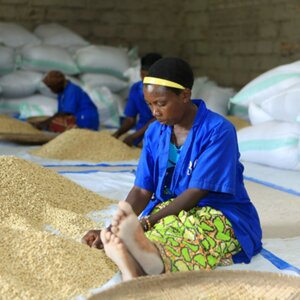
Gaudence Nyirasafari from Mushubati Sector in Rutsiro District has been recognized as an exemplary farmer because of the organic fertilizers he uses in sugarcane and rice. In addition to this fertilizer, Nyirasafari also produces pesticides and juices that enhance the taste of food.
Before he started making this fertilizer, he only farmed for himself, but now he has to buy from the markets, which helped him develop and now he has a house worth 16 million Frw.
The Genocide against the Tutsis in 1994 happened when Nyirasafari was studying in the third year of high school, but it was interrupted and he did not continue due to orphanhood, which made him slow in his development.
In 2019, after the Koica Kora Wigire training, he started making this fertilizer that changed his life, and now he is one of the model farmers invited to important agricultural exhibitions at the national level.
When the farmer prepares the compost, he takes the rice and cooks it fresh without adding salt. When it is fresh, he cleans it, washes his hands, molds it into balls, and puts it in a cool place like under a palm tree or in a house where they don’t cook. In days between three and five the rice becomes white. It uses IMO (Indigenous Micro-Organism) to make this fertilizer.
After he took rice and wheat and put them in a bucket, he used a kilo of rice and poured a kilo of sugar. Every day he goes to work. In 10 days, this mixture will become compost. Before using it, he takes one liter of this fertilizer and pours 100 liters of water into it. After opening it, he put it in an ‘arrosoir’, and went to pour it in the fields.
That age must be the same, because the water containing the fertilizer is poured over the seeds. Nyirasafari told IGIHE that the mixture in this fertilizer makes it easy so that the plant planted in it grows quickly.
He continued, “That field is always green, always white whether in the sun or in the rain.” This mother has papayas that have been treated with this fertilizer for four years and are still healthy while those who do not apply it at that time their papayas are already old.
Before expanding the area where he uses this fertilizer, Nyirasafari first tested it on one are. At that time, he made one kilo of rice and one kilo of sugar, following the instructions as he and his colleagues were trained.
The vegetables he planted cost him 400 thousand Frw. He then began to expand the area where he uses this fertilizer, and now he has reached the level of producing 20 bushels of rice and 20 bushels of sugar.
In his testimony, he says that farming helped him develop.He said, “I have a penthouse worth 16 million Frw. I’ve done all the work and all that’s left is the painting.” At the 2019 Agricultural and Livestock Exhibition, held at Mulindi, Nyirafasafari and his colleagues sold their inputs.
He says, “We got a lot of money, and the farmers we taught were happy about it. There are those who have called us later and told them over the phone how they do it.”
The owner of the safari took the drum and washed it, put it in a bucket, and poured beer over it. When he used a pound of garlic he poured five bottles of beer. After days he pours out strong wine; he often uses cognac.
Worrying about those who think it would be a waste of money, he said, “Is beer a very important thing for a person who wants to be productive? I have not been productive for a long time. I have not seen this training, I could not even take it to the market. The things that I have done as a professional will not be taken away from me to make it possible”.
This medicine has the ability to kill insects. He gave the example of mango pests known as aphids, saying that in dealing with them he first watered the tree, then sprayed it on the leaves and on the tree.
He said: “You plant it from the top of the tree, and you also plant it on the leaves and the stem, and it descends to the place where it has taken good soil. It is also possible to treat the roots, because there are times when the disease has come from the soil. So when we didn’t know how to do it three times, we got rid of it.”