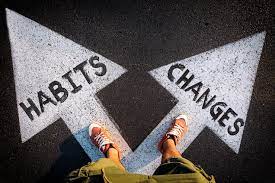
Change your behaviors if you wish to improve your life. But changing a bad habit requires more than just wishing to do so. Your life is affected by bad habits, and you can’t achieve your objectives. Your physical and emotional wellbeing are in danger because of them. They also waste your energy and time.
What is a bad habits
Bad habitsA behavior decision that has been repeated often enough to develop into an automatic routine or unconscious pattern is called a habit.
Excellence is not an act; it is a habit, to quote Aristotle. We physically become who we continually do, which means that our habits shape who we are and who we become.
You are not making poor judgments due to a lack of motivation or effort. Many times, our routines have become so intertwined with our habits that we are unaware of them.
All habits, whether good or negative, are built on this fundamental principle. A behavior is brought on by something, whether it be a visual cue, an emotion or sensation, the time of day, or a past activity. After the action, there is either positive or negative feedback. The likelihood of the action being repeated increases if the feedback appears to be a reward. Then, after repeatedly doing it, a habit is created.
how can you change bad habits?
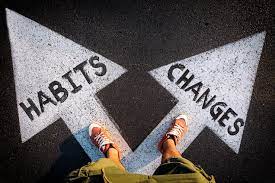
Poor habits take care of specific necessities in your life. So, it is preferable to swap out your unhealthy behaviors for superior ones that provide to the same demand. It will be challenging to maintain a pattern of “just don’t do it” for very long if you expect yourself to just stop harmful behaviors without replacing them. This is because you will have unmet demands.
Identify your bad habits
Identifying undesirable behaviors is the first step in getting rid of them. This involves a lot more self awareness than one may imagine and is much more difficult.
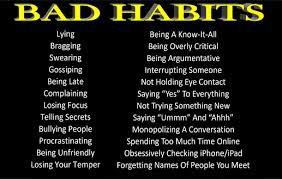
You can feel overwhelmed once you start to list some of the habits you want to stop. But, keep in mind that not every modification has to be made at once in order to see results. This is challenging and will probably lead to failure. Finding one or two habits that are preventing you from moving forward is tricky, so start there. To put it another way, only one negative behavior pattern needs to be broken at a time.
Learn what triggers your bad habits

A habit must be triggered by a cue, which could be anything. Perhaps anxiety makes you want chocolate.
Whatever it is, make a note of it and work on becoming more conscious of this trigger when it arises. It can assist if you are able to eliminate the trigger, such as hiding snacks from view or ceasing to buy them from the store.
Choose a solution for your bad habit.
You must prepare in advance for how you will act when faced with the stress or boredom that triggers your bad habit.
You need to have a strategy for what you will do in place of your bad habit, whatever it is and whatever you are dealing with.
Add Some Resistance
You are less likely to continue harmful habits if you make it more difficult to do so. Friction can help you pause and reconsider a choice, and it can also provide you bad feedback to make you less likely to make the same choice again.
Replace a bad habit with a good habit
According to research, substituting a good behavior for a negative one is more beneficial than simply ceasing the bad conduct. Your brain can’t go into autopilot because the new activity interferes with the old habit.
Choose a simple-to-repeat healthful habit.
Make simple changes
It’s typically challenging to break a habit because the activity has become routine and effortless. The contrary is also true: learning new behaviors can be challenging since your basal ganglia, or “autopilot” region of the brain, hasn’t yet taken over this behavior. You can better incorporate new behaviors into your autopilot routines by making them simpler.
Find help from others
Join forces to resign together by forming a pair. You two may hold each other accountable and share in each other’s accomplishments. A strong motivator is realizing that someone else is counting on you to perform better. Be in the company of people who lead the lifestyle you desire. While you don’t have to say goodbye to your old friends, you shouldn’t undervalue the influence of making some new ones.
Don’t give up

According to research, your past behavior is a reliable predictor of your future behavior. Because of this, it might be challenging to break bad habits. The good news is that if you persist, your new actions will also become habits. 4 Perseverance pays off; at first, getting up at 5 a.m. for a jog could be unpleasant, but eventually it will come naturally.
It’s normal to make mistakes. Remind yourself that you’re only human and it’s okay rather than beating yourself up about it. Remember that it can take more than one attempt to break the habit if you find yourself falling back into it.
Reward yourself
Use incentives or rewards to encourage yourself to improve your behaviors.
It is not necessary for it to be costly or elaborate. It might be as straightforward as a bubble bath or a favorite dish.
Consider establishing a goal for the week, and reward yourself if you succeed. You might be more likely to continue with your intention to stop that habit if you know there will be a reward later.
It’s difficult to break habits. While habits don’t develop over night, neither will they alter over night.
For new actions to become routine, patience and time are required. Changing a habit can take several weeks. Don’t give up though!